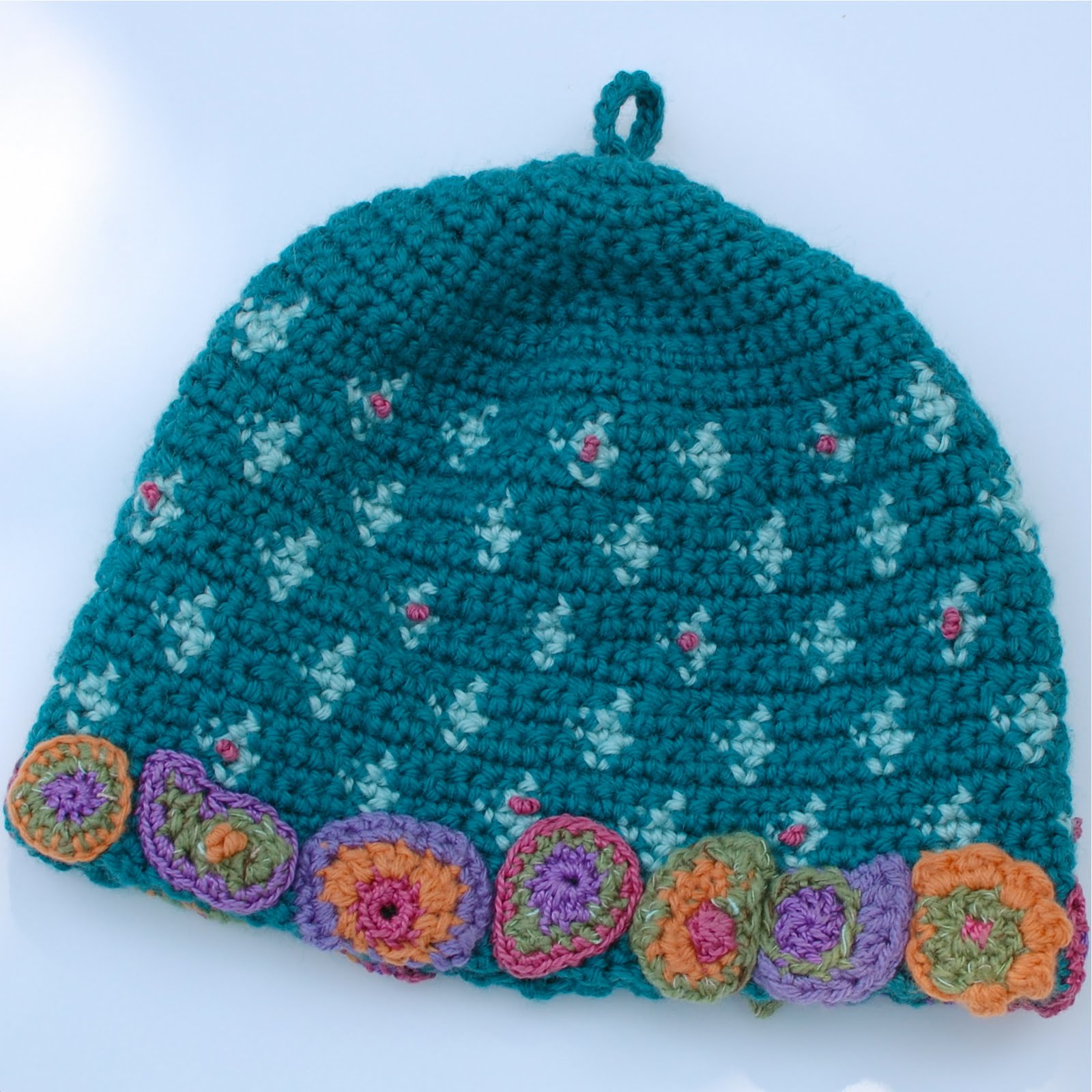
I've been so excited about figuring out how to do colorwork crochet the way a knitter would: working with color, small repetitive patterns and playing with embellishments! As I thought about it over the summer, I decided I wanted to create a visual record for myself of my early experiments. I completed the first of these mittens a couple years ago and needed to make it's mate. Thankfully, I had taken notes as I created the first one. Last week they became a pair.
My objectives were: to design a project that would put crochet on display by incorporating borders, working the largest design element into the fabric, and then embellishing to catch the eye. The technique that really came home to me as I worked the intarsia ogee is that stranding with a double twist of the carried yarn looks superior to carrying inside the stitch. My ogee appears to be solid red with no hint of the carried blue in the fabric. I'm pleased to learn that.
My prototype mittens are imperfect but they provided a great learning experience.
Thursday, September 15, 2011
Busy Summer
Greeetings! I took three months off without intending to. Over the summer Richard and I spent a good bit of time working in the yard and trying to improve the garden while keeping up with our grandchildren. We also took time for siesta in the afternoons, napping and reading, hiding from the sun. It was so humid that I didn't want to crochet.
Now at the end of the summer, the children have grown, fall veggies are in, ten blueberry bushes are on their way, and we are hoping to plant three evergreens along with some grapevines to form a natural fence on one side of the back yard.
I laughed at Richard's over-large but sturdy bean trellis. I told him it needed to survive the next hurricane but when it was finished I wondered if the pole beans could rise to such an expectation.
Now at the end of the summer, the children have grown, fall veggies are in, ten blueberry bushes are on their way, and we are hoping to plant three evergreens along with some grapevines to form a natural fence on one side of the back yard.
I laughed at Richard's over-large but sturdy bean trellis. I told him it needed to survive the next hurricane but when it was finished I wondered if the pole beans could rise to such an expectation.
Tuesday, June 14, 2011
Scrumbling Workshop
Last Saturday eight members and friends of the Fredericksburg Spinners and Weavers Guild joined me for a workshop on crocheted scrumbling. Many were new to crochet itself and had been practicing in the preceding weeks with Anne guiding them. Lynette lent us her dining room so that we could meet in a homey atmosphere, complete with friendly dogs as greeters.
After we gathered around the table, I asked everyone to relate what they had seen of scrumbling and why they wanted to learn. Several members had recently seen the "Hyperbolic Crochet Coral Reef" and the "Smithsonian Community Reef" installations of crocheted coral that were on display in Washington. The traveler's enthusiasm for this crochet installation seemed to have spread through the whole group. Also, several members work in a variety of mediums and wanted to add to their various skills.
After a short introduction and some hand-outs, we dumped all our yarn into the center of the table and began to explore the possibilities.
After we gathered around the table, I asked everyone to relate what they had seen of scrumbling and why they wanted to learn. Several members had recently seen the "Hyperbolic Crochet Coral Reef" and the "Smithsonian Community Reef" installations of crocheted coral that were on display in Washington. The traveler's enthusiasm for this crochet installation seemed to have spread through the whole group. Also, several members work in a variety of mediums and wanted to add to their various skills.
After a short introduction and some hand-outs, we dumped all our yarn into the center of the table and began to explore the possibilities.
A Group Shot
Beautiful Hands At Work
Wonderful Works In Progress
Monday, June 13, 2011
Colorwork and Scrumbles
Ready For Action
A wrist distaff is a unique aid for a spinner who works with roving rather than rolags. Rolags are short lengths of hand carded fiber and don't require much support during spinning, but roving, which is prepared on a drum carder or commercial carding machine, comes in long strips. With roving, a spinner can work either at the wheel or with a drop spindle for quite a while without stopping to lay in more fiber but the spinner needs her supply kept safely back from the twisting strand! Using the wrist distaff is simple. You tuck the end of some roving into the bracelet of your distaff, wind the supply around the tassel and attach the other end of the roving to your work in progress.
Sunday, June 12, 2011
Scrumbled Wrist Distaff
The materials are Cotton Classic yarn (most of the greens) and number 3 perle cotton (most of the yellows). Cotton Classic is a worsted weight yarn. I used a Clover size E hook throughout. It was fun to keep a bowl full of small balls of yarn by my chair and work as the spirit moved me.
When I was finished working it, I wanted to add embellishments. Beads were the first thing that came to mind but I was uncertain about finding a good range of colors and I really wanted a less expensive alternative. French knots were the perfect alternative as I already had a good selection of perle cottons. I used a handful of white knots to break up green spaces and a great shade of orange to highlight places with yellow detailing. I think the tassel with its orange wrapping accents the bracelet nicely.
Sunday, June 5, 2011
Process Equals Progress?
Somewhere along the line in my Early Childhood education I was told that process is much more important for young children than product. I don't think that amounts to the product never having any importance but, yes, I'm sure it is more important for young children to "be" in the flow of experience. I was surprised then, when my teenagers in First Day School wanted to make yards and yards of finger knitting and just roll it up into giant balls - not make anything from it despite my suggestions - just contain it in a large spherical stash and keep going. What did I take from this? Older children, of course, also need process without a focus on product. And maybe adults do, too.
As adults, when we craft something well, we are often in process for years, maybe for the course of our lifetime yet there is a difference between the work of a child simply experiencing a material, a technique, a tool. At some point we begin to work with a purpose, toward an end. First it might be a single project, then a series of projects to explore an idea. Over the long term, we might come to want to contribute to an entire body of work that is available in the world. I hope to share some crochet techniques with the entire crochet community. My book Contemplative Crochet is meant to share my connections of the spiritual to the work of our hands and through this blog I want to share my fascination with the development and use of our hands, especially as we create beautiful and useful products. It is all process!
How do we get there? How important are our earliest experiences with process? I suspect those early forays lay the groundwork for curiosity, creativity, and perseverance. Each kind of process leads to the next. So, even for adults, maybe the place to start any new project is just with basic materials, a playful attitude and an intention to enjoy the process.
As adults, when we craft something well, we are often in process for years, maybe for the course of our lifetime yet there is a difference between the work of a child simply experiencing a material, a technique, a tool. At some point we begin to work with a purpose, toward an end. First it might be a single project, then a series of projects to explore an idea. Over the long term, we might come to want to contribute to an entire body of work that is available in the world. I hope to share some crochet techniques with the entire crochet community. My book Contemplative Crochet is meant to share my connections of the spiritual to the work of our hands and through this blog I want to share my fascination with the development and use of our hands, especially as we create beautiful and useful products. It is all process!
How do we get there? How important are our earliest experiences with process? I suspect those early forays lay the groundwork for curiosity, creativity, and perseverance. Each kind of process leads to the next. So, even for adults, maybe the place to start any new project is just with basic materials, a playful attitude and an intention to enjoy the process.
Subscribe to:
Posts (Atom)