Sometimes I forget how much jumpin' juice I get from being around young people. Given that, it's a good thing I volunteered to teach a local Girl Scout troop to knit. They weren't sure they even wanted to mess around with yarn and needles but with each success: slip knot, casting on, knit stitch, they have gotten more hooked. We had a problem at first, over how to get them here after school with their work. It seems the school considers knitting needles to be weapons. That seems strange to me considering that a number of teachers across the country are having a lot of success with getting their students to listen with greater focus while doing something quiet with their hands, including knitting. The problem resolved itself from our end when I showed the girls how to make their own needles from chopsticks and their leader brought some large stitch holders. Now they have an extra set of needles here at my house (along with the satisfaction of learning to make their own tools) and they can transfer their fabric to their stitch holders to carry it home and put it on a set of needles there. I will add that the juice this week came not only from knitting but also from finding out that these kids love old silly songs. Think Purple People Eater!
Friday, March 4, 2011
Tuesday, February 22, 2011
Crochet A Hyperbolic Plane
Of course, Liam needed a "Curly" of his own so I asked him what colors he would like and whipped this one up for him. The two playthings I made, one of which I gave to Kate and one to Liam were very easy to crochet. I thought you might like the instructions to make one yourself.
| Liam's Curly |
Curly
Materials:
Good cabled, cotton yarn
A size G crochet hook (I used a Susan Bates.)
A yarn needle
Scissors
Chain 10. Turn.
Row 1: Skip one chain and *single crochet in the next chain, single crochet in the next chain, 2 single crochets in the next chain, repeat from the asterisk 2 more times, turn.
Row 2: Chain 1, single crochet in the first single crochet of the row below, single crochet in the next stitch, 2 single crochets in the next stitch, repeat across the row. To change colors for a striped "curly" pull through the last two loops of the last stitch with the new color.
Repeat this pattern of single crochet in each of two stitches, two single crochets in the next stitch, for every row, changing colors every two rows (carry the unused colors up the side). Sometimes there will be extra stitches at the end of a row. Single crochet in each one, then after turning start the pattern again.
I worked ten rows for a piece about 4 1/2 inches across.
Sew the two flat edges together, incorporating the carried strands.
Thread the needle through the stitches in the center and tighten it up.
With a contrasting yarn, overcast stitch through the top of each single crochet in the last row.
Thread in any remaining ends.
Sunday, February 13, 2011
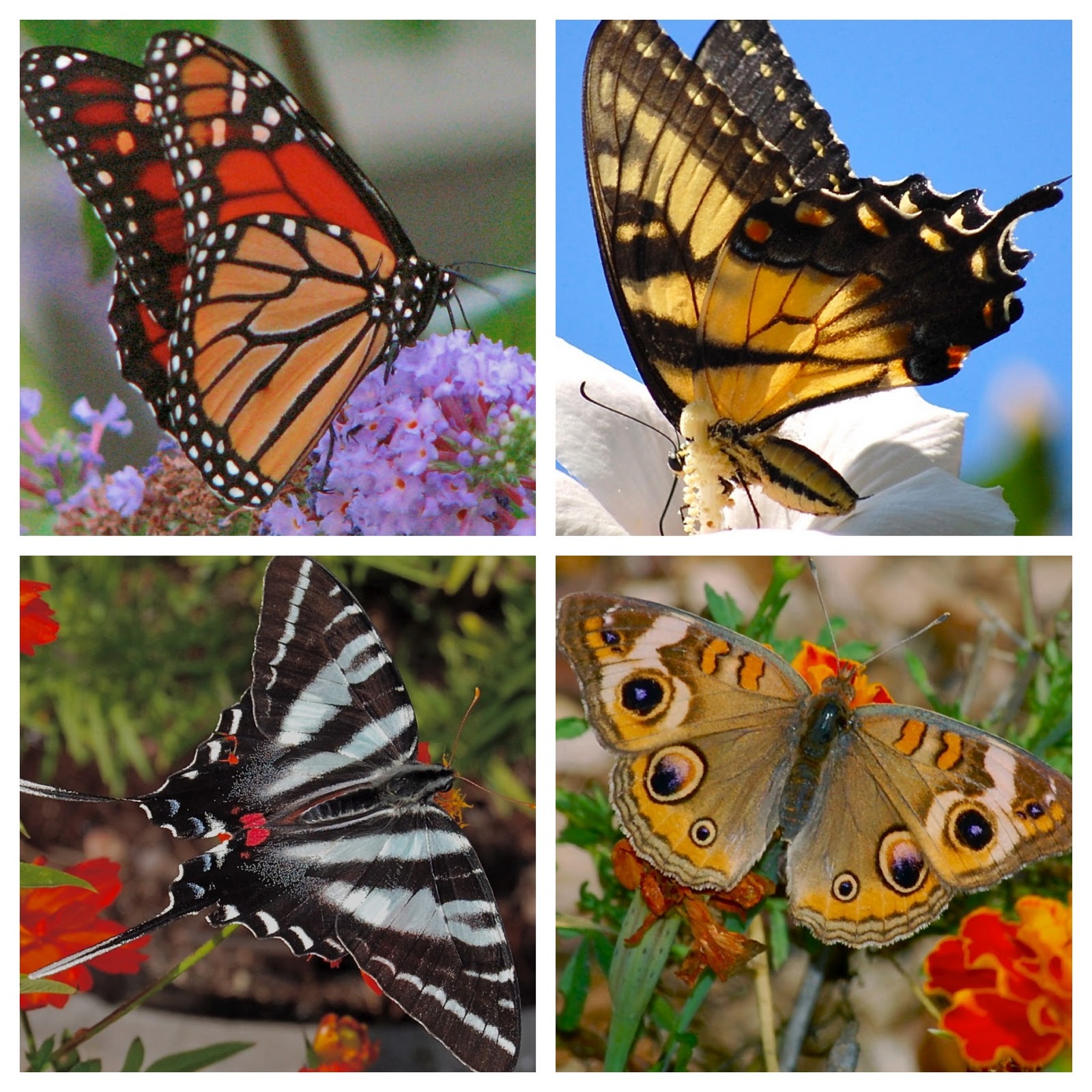
Wing Patterns
Here is visual inspiration to share. My husband, Richard, took these photos separately and only recently combined them for this grouping. Each butterfly presents such beautiful colors, lines and forms, yet together they are even more exciting. Maybe they will give you some ideas for your own craft work.
Kate's Curly
Here, I think, is an interesting example of the idea of domain change. From knowing crochet as a tool for designing pretty or useful items that are usually made from fabric, Daina Taimina created a paradigm shift when she saw crochet as a scientific/mathematical tool. She was seeking a concrete and mathematical way to express constant negative curvature (the hyperbolic plane). This curvature is found in nature in plants like curly kale and animals like the nudibranch. She is now well known among mathematicians and crocheters alike.
I have a copy of Daina's book, Crocheting Adventures with Hyperbolic Planes. The other day it called to me to pick it up. I read the first chapter and then set my hands to this strange form. After about ten rows I stopped to play with it, variously: opening it up, folding it, twisting it and wondering whether I should sew the side edges together or leave it as it is. I wasn't sure. In the end, I sewed it up and recognized it as a very cool baby toy, making my own domain shift. It is soft and lightweight, easy to pick up, colorful, can be packed into a pocket and shaken back into shape. As you can see Kate is a great tester!
My Own Hand-Brain Connection
I can put my finger on a specific place, on a specific night when I became consciously aware that in pursuing my own handwork skills, creatively, I had changed my brain, maybe my IQ and definitely the way I would look at handwork forever after - even the way I would see the world.
I had gained a material compass. I understood that all material has its limits of size; things can only be built so large or so small without reaching the limits of the material. I understood that all material had a grain, a bias, a dimensionality, and that to make something in 3-dimensions, those factors in the source material had to be taken into account. Wood, fiber, fabric, metal and even the universe has its own limits to be reckoned with. Yet within those limits, creativity is boundless.
I understood something of the ideas of telescoping and spiraling. Think of: nesting boxes, matroyshkas, a photographer photographing a photographer, photographing a photographer.... These are good skills to have when deciding the form of an object coupled with its texture, line, pattern and color or when changing sizes and proportions. The brain must be able to slip-slide with purpose. Isn't it true? And sometimes we shut down and forget those functions when we most need to transfer them, as in scheduling a hectic day or planning a complex meal. Another thing I learned was how to keep the overall picture in my mind while paying attention to details.
How did I learn all these things? Mostly by pursuing a range of fiber crafts that culminated in original doll making. They taught me skills and philosophy I could never have learned in school. I strongly support handwork as an educational endeavor!
I had gained a material compass. I understood that all material has its limits of size; things can only be built so large or so small without reaching the limits of the material. I understood that all material had a grain, a bias, a dimensionality, and that to make something in 3-dimensions, those factors in the source material had to be taken into account. Wood, fiber, fabric, metal and even the universe has its own limits to be reckoned with. Yet within those limits, creativity is boundless.
I understood something of the ideas of telescoping and spiraling. Think of: nesting boxes, matroyshkas, a photographer photographing a photographer, photographing a photographer.... These are good skills to have when deciding the form of an object coupled with its texture, line, pattern and color or when changing sizes and proportions. The brain must be able to slip-slide with purpose. Isn't it true? And sometimes we shut down and forget those functions when we most need to transfer them, as in scheduling a hectic day or planning a complex meal. Another thing I learned was how to keep the overall picture in my mind while paying attention to details.
How did I learn all these things? Mostly by pursuing a range of fiber crafts that culminated in original doll making. They taught me skills and philosophy I could never have learned in school. I strongly support handwork as an educational endeavor!
Friday, February 11, 2011
Original Wrist Distaffs
My husband has been playing around with a new application called Diptic on his iPad. He presented me with this little gift this morning after shooting the photos of my newest wrist distaffs. I love this small collage! I want to learn how to use Diptic myself. In the meantime, both distaffs have been added to my Etsy shop. For those who don't know, a wrist distaff is a wonderful way to keep a supply of roving ready for drawing out and spinning. It makes drop spindling much more fun.
Thursday, January 27, 2011
Little Explorers
Very young children want to explore everything in their world and their most important organ for doing that is their hands. In their unconscious manner, children want to know about the properties of materials: metal, rubber, plastic, wood, stone, fiber. They need to experience by feeling, such characteristics as smooth, hard, bumpy, rough, crumbly, floppy, and rigid. And, yes, it is very important to safely learn hot and sharp!
Yet, too often, we abruptly tell them, "no!" or slap their hands when it really isn't necessary. I worked in a toy store for twenty years and I wish there had been more parents, who, instead of keeping small fingers completely at bay had been actively teaching their children how to touch and giving them the language and the experience necessary for further growth.
Young children need to pet, stroke, bang and manipulate all kinds of items made out of all kinds of materials. The most child friendly environment is one in which children have a rich variety of things they are allowed to manipulate: blocks made from different kinds of wood, books both hard cover and paperback, magazines, leather purses and belts, bits of silk, velour and wool, baskets, simple tools and age-appropriate goodies from the hardware store. The nerve endings in our fingers are among our most important assets and children with rich early experiences will be on intellectually sound ground toward preparation for later learning.
Yet, too often, we abruptly tell them, "no!" or slap their hands when it really isn't necessary. I worked in a toy store for twenty years and I wish there had been more parents, who, instead of keeping small fingers completely at bay had been actively teaching their children how to touch and giving them the language and the experience necessary for further growth.
Young children need to pet, stroke, bang and manipulate all kinds of items made out of all kinds of materials. The most child friendly environment is one in which children have a rich variety of things they are allowed to manipulate: blocks made from different kinds of wood, books both hard cover and paperback, magazines, leather purses and belts, bits of silk, velour and wool, baskets, simple tools and age-appropriate goodies from the hardware store. The nerve endings in our fingers are among our most important assets and children with rich early experiences will be on intellectually sound ground toward preparation for later learning.
Subscribe to:
Posts (Atom)